So we've been engaging in educational pursuits lately, really. Many of my plans have been stymied by the nasty cold I've had for the past two weeks. K also threw a wrench in my plans for starting with a week on castles and the Middle Ages by developing a grand passion for the ocean and fish.
I'm finding myself often being caught wondering where I draw the line between insisting K do the things I have planned and deciding that the advantage of homeschooling is that we can follow her passions. When it comes to reading and math, I'm good at staying firm, although I might make compromises like letting her spend more time on Reading Eggs or put off a handwriting assignment until tomorrow. But with everything else, my feeling is that in first grade, it's only reading and math that have a particular level that a child should be able to achieve. As for the other subjects, it's important that they learn history, science, art, health, etc. But there is anything in particular in those subjects that you can point to and say, "A first grader should know that." It's not like she should be expected to know American history through the War of 1812 and have a good grasp of geology. So since our approach is that she should be exposed to these subjects but the actual topics we cover are entirely up to us, it's hard to insist that we absolutely must be learning about castles when all she's interested in is dolphins and sea anemones.
So we finished up The Duchess Bakes a Cake and our study of the micro-organisms that help make our food by making bread and yogurt, then moved on to Very Last First Time, the story of an Inuit girl in Canada who goes beneath the sea ice at low tide to gather mussels on her own for the first time.
And here was where I ran into a problem I've worried about since embarking on FIAR: what if K refuses to read the main book? We had a bit of this with Cranberry Thanksgiving, but I was able to get her to listen to it after some persuasion. The thing is, sometimes K will take one look at something and decide she absolutely does not like it and will not be moved on the subject. She's extremely stubborn, and I have learned that fighting it head-on is the worst possible approach if it's not something that's really important (stubborn refusal won't get her out of a trip to the dentist or picking up her toys, for instance). It's better to try and take a different angle or give her time to warm up to it after some persuasion. In this case, for reasons she wouldn't or couldn't explain, K refused to read Very Last First Time. And I was getting sick and was nearly seven months pregnant and just didn't have the patience to work her around to it.
So I decided that there was nothing stopping us from covering the topics I had planned on covering. So we read lots of books on the Arctic and spent quite a bit of time looking up information on the sea animals that live there. We did a lesson in pontillism, which is the style Very Last First Time is illustrated in, but works fine as a standalone topic. K developed a passion for sled dogs, so we looked up information on them and K spent quite a bit of time getting pulled around in a laundry basket by her visiting grandfather.
From there, we moved on to Owl Moon, by Jane Yolen, with more success. I'm hoping to finish it up in the next couple days, so it will get an entry of its own.
Monday, February 13, 2012

Wednesday, February 8, 2012
Alec at two and a half
Today, Alec put together a 12 piece puzzle. Admittedly, it was the kind where you put the pieces over an identical picture, so he had the help of being able to match the piece to the picture, but even being able to do that it pretty good for a two year old. And it was a reminder that while development isn't as dramatic in late toddlerhood as it is in the first two years, they still have a way of sneaking new skills in behind your back to surprise you.
Cognitive: Alec has been very interested in letters for a while and recently started in on numbers. He can name a bunch of letters (one of his favorite toys for a while has been a little electronic toy that says the name of a letter when you press the corresponding key) and can often be heard wandering around counting. In fact, he's making discipline with K a bit difficult because I sometimes use the count to three method, only when I say "One..." he then fills in "Two, three, four!" It's remarkably hard to maintain good discipline when you're having trouble keeping a straight face. I have heard him count to five (as in, associating numbers with objects) and recite numbers up to 15. He knows a wide variety of shapes and colors.
He is particularly interested in music these days, and thanks to Little Einsteins, can identify a number of instruments as well as melody lines to various pieces of classical music. I think we will definitely getting him music lessons when he's a bit older, although I'm not sure where to start because the Suzuki method has never really appealed to me.
Verbal: He talks a lot, but has definite issues with articulation, so good luck understanding him. He's getting more and more intelligible though. When K was his age, I spent a long time trying to figure out how any child who had said as many words as she had could talk so little. Eventually, after she finally started talking regularly, I realized it was because while she had vocabularly, she had trouble with articulation and wasn't willing to say things if she couldn't do it correctly. Alec has the same articulation issues, but the difference is that he's never let a little thing like intelligibility get in the way of what he has to say. The cheerful babbling is slowly developing into cheerful words that we can understand now, which is fun to watch develop.
Physical: At his two year appointment, he was 33 1/2 pounds and 38 inches tall, which is 95 percentile for weight and off the charts for height (for reference, those were K's measurements at her 3 year appointment, and she's never been small). He's certainly bigger now, although I don't know how much.
In gross motor skills, he can now walk up stairs one at a time while holding onto something, and step down them as well, although he prefers to sit down and bump his way down them. He can't jump yet, although he can do the incredibly cute crouch and leap up without his feet actually leaving the ground. He is adept on the playground and I think there is very little he can't climb.
In terms of fine motor skills, he's getting closer to coloring within the lines of pictures. I haven't been able to tease out anything representational in his art yet, but he holds crayons and pencils correctly (he was absolutely fascinated with his sister's handwriting book tonight, but I was too mean to let him scribble in it).
I finally had to give him a real haircut after his adorable baby curls turned into out of control shagginess. He's such a big boy now, in so many ways.

Cognitive: Alec has been very interested in letters for a while and recently started in on numbers. He can name a bunch of letters (one of his favorite toys for a while has been a little electronic toy that says the name of a letter when you press the corresponding key) and can often be heard wandering around counting. In fact, he's making discipline with K a bit difficult because I sometimes use the count to three method, only when I say "One..." he then fills in "Two, three, four!" It's remarkably hard to maintain good discipline when you're having trouble keeping a straight face. I have heard him count to five (as in, associating numbers with objects) and recite numbers up to 15. He knows a wide variety of shapes and colors.
He is particularly interested in music these days, and thanks to Little Einsteins, can identify a number of instruments as well as melody lines to various pieces of classical music. I think we will definitely getting him music lessons when he's a bit older, although I'm not sure where to start because the Suzuki method has never really appealed to me.
Verbal: He talks a lot, but has definite issues with articulation, so good luck understanding him. He's getting more and more intelligible though. When K was his age, I spent a long time trying to figure out how any child who had said as many words as she had could talk so little. Eventually, after she finally started talking regularly, I realized it was because while she had vocabularly, she had trouble with articulation and wasn't willing to say things if she couldn't do it correctly. Alec has the same articulation issues, but the difference is that he's never let a little thing like intelligibility get in the way of what he has to say. The cheerful babbling is slowly developing into cheerful words that we can understand now, which is fun to watch develop.
Physical: At his two year appointment, he was 33 1/2 pounds and 38 inches tall, which is 95 percentile for weight and off the charts for height (for reference, those were K's measurements at her 3 year appointment, and she's never been small). He's certainly bigger now, although I don't know how much.
In gross motor skills, he can now walk up stairs one at a time while holding onto something, and step down them as well, although he prefers to sit down and bump his way down them. He can't jump yet, although he can do the incredibly cute crouch and leap up without his feet actually leaving the ground. He is adept on the playground and I think there is very little he can't climb.
In terms of fine motor skills, he's getting closer to coloring within the lines of pictures. I haven't been able to tease out anything representational in his art yet, but he holds crayons and pencils correctly (he was absolutely fascinated with his sister's handwriting book tonight, but I was too mean to let him scribble in it).
I finally had to give him a real haircut after his adorable baby curls turned into out of control shagginess. He's such a big boy now, in so many ways.
Tuesday, January 24, 2012
Snippets
* I took K to see Beauty and the Beast 3d last week. It was fun to have the opportunity to take her to see another Disney princess movie in the theatre. We could have done completely without the 3d - the best I can say about it is that it didn't take away from the experience much. I mean, I recognize that even seen in the theatre, after 20 years (!) of revolutions in animation, including seeing what Miyazaki can do with hand-drawn animation it wasn't going to blow me away the way it did when I saw it the first time. But it's still a beatifully drawn movie, and the 3d made me think of some sort of 70s animation gimmick that doesn't quite hit the mark. Note to Disney: landscape that looks like a bunch of flat layers propped up in rows to give the illusion of depth as you move past them isn't what I would call an effective 3d experience.
* Alec often will sit and "read" books to himself, which has progressed in detail from the early days of merely going through books of animals and making the noise for each animal he sees to going through each page of Sandra Boynton's Doggies and saying "One dog - woof! Two dog - woof, yap!" etc. Today, he was reading through Peter Spier's Oh, Were They Ever Happy! (a childhood family favorite which serves as an excellent cautionary tale on what an ominous sentence "But the sitter never showed up" can be) by saying "Uh oh, paint!" on every page. Which just about perfectly sums up the plot of the book.
* I reached 26 weeks yesterday, the cusp of the third trimester. How did that happen? Mercifully, the pelvic pain hasn't kicked in yet, but my back (and sciatic nerve) is starting to realize that I'm pregnant. According to every test in this overmedicalized pregnancy, Godric is doing fine and growing well. He led the ultrasound tech on a merry chase for 45 minutes during the fetal echocardiogram (his heart is fine), and then lay sleeping sweetly nestled against my hip during the growth ultrasound two weeks ago (his growth is also fine), nicely covering up several parts that needed to be measured. He is certainly related to his big sister, the queen of ultrasound non-cooperation and fetal contrariness. I saw the cardiologist my ob wanted me to see last week and my heart is fine too (it always has been, just overenthusiastic). Meanwhile, Godric continues to happily kick away.
* I found the most fantastic children's series today at work - The Penderwicks by Jeanne Birdsall. It looks exactly like one of the various happy family series written between 1920 and 1960 (The Moffats, All-of-a-Kind Family, The Bobbsey Twins before they started solving mysteries, etc.), but actually started in 2005. In fact, I passed it up the first time I saw it in our booksale room because I was sure we already had it in the library because we have all of those classic series. But no, it's actually a modern series, although it's next to impossible halfway through book one to figure out when it's taking place because there's been no mention of technology.
I think the thing I love about it is that it has all of the good aspects of those classic series without many of the drawbacks. The four-year-old, for instance, is captured wonderfully, without the horrible tweeness that seems required for this sort of book. All of the characters, in fact, so far seem to have a realistic blend of good and bad points and I suspect even the villain in the end will wind up being not so bad. Their problems are real problems, not nonexistent issues created solely in the minds of children because ha ha, children are Like That, aren't they and isn't that what makes them so funny? Best of all, a modern author means I've been able to read without wincing my way through rampant sexism and racism. I'm already looking forward to getting to B's library tomorrow to check out the other two books in the series as well as what looks like an absolutely charming picture book by the same author about a girl and her little brother who get blown away by the wind.
* Alec often will sit and "read" books to himself, which has progressed in detail from the early days of merely going through books of animals and making the noise for each animal he sees to going through each page of Sandra Boynton's Doggies and saying "One dog - woof! Two dog - woof, yap!" etc. Today, he was reading through Peter Spier's Oh, Were They Ever Happy! (a childhood family favorite which serves as an excellent cautionary tale on what an ominous sentence "But the sitter never showed up" can be) by saying "Uh oh, paint!" on every page. Which just about perfectly sums up the plot of the book.
* I reached 26 weeks yesterday, the cusp of the third trimester. How did that happen? Mercifully, the pelvic pain hasn't kicked in yet, but my back (and sciatic nerve) is starting to realize that I'm pregnant. According to every test in this overmedicalized pregnancy, Godric is doing fine and growing well. He led the ultrasound tech on a merry chase for 45 minutes during the fetal echocardiogram (his heart is fine), and then lay sleeping sweetly nestled against my hip during the growth ultrasound two weeks ago (his growth is also fine), nicely covering up several parts that needed to be measured. He is certainly related to his big sister, the queen of ultrasound non-cooperation and fetal contrariness. I saw the cardiologist my ob wanted me to see last week and my heart is fine too (it always has been, just overenthusiastic). Meanwhile, Godric continues to happily kick away.
* I found the most fantastic children's series today at work - The Penderwicks by Jeanne Birdsall. It looks exactly like one of the various happy family series written between 1920 and 1960 (The Moffats, All-of-a-Kind Family, The Bobbsey Twins before they started solving mysteries, etc.), but actually started in 2005. In fact, I passed it up the first time I saw it in our booksale room because I was sure we already had it in the library because we have all of those classic series. But no, it's actually a modern series, although it's next to impossible halfway through book one to figure out when it's taking place because there's been no mention of technology.
I think the thing I love about it is that it has all of the good aspects of those classic series without many of the drawbacks. The four-year-old, for instance, is captured wonderfully, without the horrible tweeness that seems required for this sort of book. All of the characters, in fact, so far seem to have a realistic blend of good and bad points and I suspect even the villain in the end will wind up being not so bad. Their problems are real problems, not nonexistent issues created solely in the minds of children because ha ha, children are Like That, aren't they and isn't that what makes them so funny? Best of all, a modern author means I've been able to read without wincing my way through rampant sexism and racism. I'm already looking forward to getting to B's library tomorrow to check out the other two books in the series as well as what looks like an absolutely charming picture book by the same author about a girl and her little brother who get blown away by the wind.
Saturday, January 14, 2012
FIAR: A New Coat for Anna
In the week after Christmas, we made a stab at schoolwork by rowing A New Coat for Anna. We didn't do it justice, since we only covered the fiber arts aspects of the book, but K's grandmother, who both spins and has dyed wool, was here and that made a great opportunity to do something fun enough to capture K's attention even in the Christmas season while we had a great resource present. Anna has lots of other aspects that are worth covering, so I'm hoping that we can pull it out again either to row on its own or as a supplement to other books with similar themes.
In A New Coat for Anna, a young girl living in post-war Europe (country unspecified, but most likely Germany, The Netherlands or somewhere in Scandinavia from the names) needs a new coat but she and her mother have no money. So her mother gathers up their valuables and proceeds to trade them for the things needed to make a coat - wool from a farmer, spinning it into thread and weaving it into cloth, then finally a tailor to make the cloth into a coat. So K's grandmother came for Christmas bearing several wool fleeces and her spinning wheel. They started with spinning, a process that fascinated both children. They wound up spinning enough yarn for a pair of mittens.
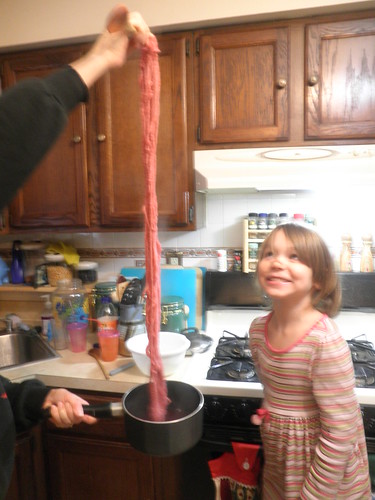
Then came the really exciting part: dyeing. In Anna, Anna and her mother use lingonberries to dye the cloth. I considered going to IKEA and getting either lingonberry juice or lingonberry cordial for the dyeing, but I was a bit worried about the high sugar content and how well it might wash out (in retrospect, it occurred to me that people use things like blueberries which are quite sweet and they seem to come out okay, so it probably would have been fine). Then I saw had used cranberries for the same project. Coincidentally, my absentmindedness around Thanksgiving had resulted in the purchase of four bags of cranberries, so we were well set in that respect. We simmered the cranberries the evening before and left them in the refrigerator overnight. The next day, we strained out the cranberries and added some vinegar, then put it back on the stove and added a skein of yarn.

After a while, it was a nice dark pink and we took it out and rinsed it a couple times to get out the excess dye.
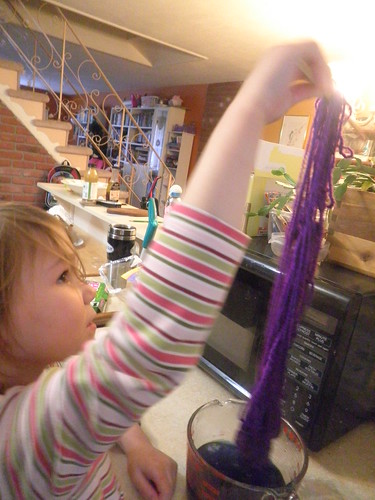
For variety, we also experimented with easter egg dye. K decided she wanted purple, but there was only one tablet, which didn't seem like enough, so I experimented with combining the blue and red/pink shades until I came up with a comparable purple color and mixed them together. We added the yarn and heated it in the microwave. Less than ten minutes later, we had a lovely purple yarn.
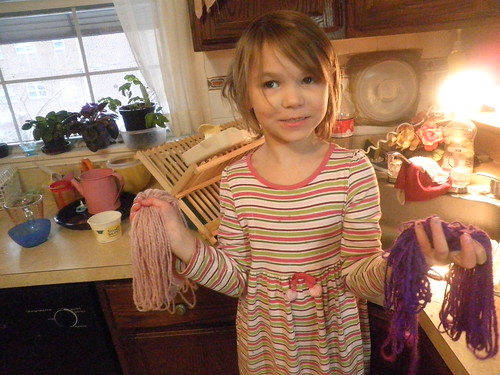
In the end, we wound up with one pink skein and one purple, which will be made into a lovely pair of striped mittens.
After taking a week off to go to Michigan, we started out this week talking a bit more about textile production. We read a bit on making cloth from cotton (from the every-useful What Do People Do All Day? by Richard Scarry), then pulled out the good old potholder loom for a lesson in weaving. K turned out not to be terribly interested, and after she played around with it enough to demonstrate that she understood how to weave, I decided she could probably happily live life without having made a highly synthetic potholder that will melt if used on something too hot and ended the lesson. I think I am going to try to teach her to knit soon - she was very excited about the idea of making a blanket for the baby, and while I think that will probably be too much for her attention span, she could certainly do a nice doll blanket, or maybe I could convince her to make a hat for the baby instead.
In A New Coat for Anna, a young girl living in post-war Europe (country unspecified, but most likely Germany, The Netherlands or somewhere in Scandinavia from the names) needs a new coat but she and her mother have no money. So her mother gathers up their valuables and proceeds to trade them for the things needed to make a coat - wool from a farmer, spinning it into thread and weaving it into cloth, then finally a tailor to make the cloth into a coat. So K's grandmother came for Christmas bearing several wool fleeces and her spinning wheel. They started with spinning, a process that fascinated both children. They wound up spinning enough yarn for a pair of mittens.
Then came the really exciting part: dyeing. In Anna, Anna and her mother use lingonberries to dye the cloth. I considered going to IKEA and getting either lingonberry juice or lingonberry cordial for the dyeing, but I was a bit worried about the high sugar content and how well it might wash out (in retrospect, it occurred to me that people use things like blueberries which are quite sweet and they seem to come out okay, so it probably would have been fine). Then I saw
After a while, it was a nice dark pink and we took it out and rinsed it a couple times to get out the excess dye.
For variety, we also experimented with easter egg dye. K decided she wanted purple, but there was only one tablet, which didn't seem like enough, so I experimented with combining the blue and red/pink shades until I came up with a comparable purple color and mixed them together. We added the yarn and heated it in the microwave. Less than ten minutes later, we had a lovely purple yarn.
In the end, we wound up with one pink skein and one purple, which will be made into a lovely pair of striped mittens.
After taking a week off to go to Michigan, we started out this week talking a bit more about textile production. We read a bit on making cloth from cotton (from the every-useful What Do People Do All Day? by Richard Scarry), then pulled out the good old potholder loom for a lesson in weaving. K turned out not to be terribly interested, and after she played around with it enough to demonstrate that she understood how to weave, I decided she could probably happily live life without having made a highly synthetic potholder that will melt if used on something too hot and ended the lesson. I think I am going to try to teach her to knit soon - she was very excited about the idea of making a blanket for the baby, and while I think that will probably be too much for her attention span, she could certainly do a nice doll blanket, or maybe I could convince her to make a hat for the baby instead.
Thursday, January 12, 2012
The last straw
We came to the conclusion this morning that we need to do something I really don't want to do: move. I really can't describe how much I don't want to do this. There are many things we love about this house, and we've done things like unpack the good china, hang pictures and put up a swingset. But the management company has gone from requiring weeks of nagging to make repairs to refusing to do them entirely. Our landline phone hasn't worked since the beginning of June, and I admit that the lease is a bit vague about whose responsibility the phone lines are (the phone service itself is ours, but the actual wiring in the house itself we feel is the owner's responsibility). But this morning when they refused to fix the broken garbage disposal, which is preventing the sink from draining properly and causing waste water from the dishwasher to back up into the sink when we run it was entirely unacceptable. Leaving aside the issue of the fact that the garbage disposal is an appliance specifically mentioned in the lease as being their responsibility, the ability to have water drain down our kitchen sink is something any reasonable tenant should be able to expect.
Sigh. I don't want to pack up all of our crap again. I really don't want to have to spend money we don't have right before adding another person to the family and a temporary reduction in income. The last thing K's schooling needs is the disruption of moving right before the disruption of a baby comes along. But we can't live in a house where things don't get fixed, and I have a strong feeling that since our lease is up at the end of February and we'll be moving to a month-to-month lease, if we call in a lawyer, we'll find ourselves having to move anyway, but not on our timetable.
Fortunately, we are close to the end of our lease, and I found at least three good-looking listings today. I've actually spent a lot of today reminding myself it's foolish to fall in love with an online house listing, since you can't really tell dimensions from online photos. Actually, I really like two of the listings for very different reasons (the third is essentially identical to our current house, but less stylish, although I'm willing to put up with ugly paneling for $100 less a month). I'm going to try to set up a schedule for us to go through the house systematically and purge and pack everything that's not vital to everyday life (while I will be eternally grateful to B's parents for all of the packing and moving they did during our last move since I didn't have the time to do it myself, it did have the drawback that I didn't get the chance to do some purging that would have been useful).
Argh, argh, argh. Contemplating all of this just makes me so tired. It definitely needs to get done before the baby arrives, since if there's anything worse than trying to move in your third trimester, it's trying to move while recovering from a c-section and breastfeeding a newborn. But that doesn't mean that moving in my third trimester is going to be a picnic either. I'm just hoping this will all coincide with nesting impulses and give me the kick I need to get unpacked promptly.
Sigh. I don't want to pack up all of our crap again. I really don't want to have to spend money we don't have right before adding another person to the family and a temporary reduction in income. The last thing K's schooling needs is the disruption of moving right before the disruption of a baby comes along. But we can't live in a house where things don't get fixed, and I have a strong feeling that since our lease is up at the end of February and we'll be moving to a month-to-month lease, if we call in a lawyer, we'll find ourselves having to move anyway, but not on our timetable.
Fortunately, we are close to the end of our lease, and I found at least three good-looking listings today. I've actually spent a lot of today reminding myself it's foolish to fall in love with an online house listing, since you can't really tell dimensions from online photos. Actually, I really like two of the listings for very different reasons (the third is essentially identical to our current house, but less stylish, although I'm willing to put up with ugly paneling for $100 less a month). I'm going to try to set up a schedule for us to go through the house systematically and purge and pack everything that's not vital to everyday life (while I will be eternally grateful to B's parents for all of the packing and moving they did during our last move since I didn't have the time to do it myself, it did have the drawback that I didn't get the chance to do some purging that would have been useful).
Argh, argh, argh. Contemplating all of this just makes me so tired. It definitely needs to get done before the baby arrives, since if there's anything worse than trying to move in your third trimester, it's trying to move while recovering from a c-section and breastfeeding a newborn. But that doesn't mean that moving in my third trimester is going to be a picnic either. I'm just hoping this will all coincide with nesting impulses and give me the kick I need to get unpacked promptly.
Monday, January 9, 2012
Happy New Year
Well, look at that - over a week into the new year and I haven't managed to write anything yet. Our holidays were very nice and low-key, yet by the time every evening rolled around, I was more interested in collapsing than typing. I'm still mostly feeling fine, but I think the third trimester is creeping up on me.
Anyway, B's parents were here for Christmas and it was wonderful, then we packed up and went to my mother's for a New Year's Christmas celebration with my brother and that was lovely, then we swung through Indiana and Ohio to see various friends and relations. A good time was had all around, the driving was surprisingly pleasant and we're awfully glad to be home.
I suppose now this means we need to get back to school again. We did engage in educational activities after Christmas, but although I brought books along, we didn't manage anything while we were in Michigan. I'm really trying to get us more organized this year. Hopefully if we can get ourselves in better habits in the next three months, we'll be in better shape to keep them up when we add another child. To this end, I'm going to try making extensive use of Google calendar, as well as setting up a chore chart for K and a concrete school schedule. I planned out our FIAR books through April today, and hopefully this week I'll get a booklist set up to go with each topic. After the baby comes, my plan is to only do math and reading until probably the end of the school year.
Anyway, B's parents were here for Christmas and it was wonderful, then we packed up and went to my mother's for a New Year's Christmas celebration with my brother and that was lovely, then we swung through Indiana and Ohio to see various friends and relations. A good time was had all around, the driving was surprisingly pleasant and we're awfully glad to be home.
I suppose now this means we need to get back to school again. We did engage in educational activities after Christmas, but although I brought books along, we didn't manage anything while we were in Michigan. I'm really trying to get us more organized this year. Hopefully if we can get ourselves in better habits in the next three months, we'll be in better shape to keep them up when we add another child. To this end, I'm going to try making extensive use of Google calendar, as well as setting up a chore chart for K and a concrete school schedule. I planned out our FIAR books through April today, and hopefully this week I'll get a booklist set up to go with each topic. After the baby comes, my plan is to only do math and reading until probably the end of the school year.
Thursday, December 22, 2011
FIAR: The Duchess Bakes a Cake, day 1 and 2
The Duchess Bakes a Cake is the story of a medieval duchess who gets bored one day and decides to make a cake. She adds some yeast, and then adds some more yeast, and then more for good measure. The results are about what you would expect for a children's storybook, which is to say it completely ignores the fact that all the yeast in the world can only make a finite amount of dough stretch so far and the resulting cake carried the duchess far above the castle.
With a story like that, you obviously would have to spend time talking about baking and the role of leaveners. We started with yeast. I showed K a couple Good Eats episodes featuring yeast, because if there's a better way explain how yeast works than with belching sock puppets, I haven't seen it. After that, we moved onto the hands-on portion of the lesson. First, we tried setting out two mixtures of warm water and yeast, one with sugar and one without. Within fifteen minutes, it was clear that sugar is necessary to fuel the yeast, since the mixture with sugar was bubbling merrily away and the plain water mixture was sitting there tepidly. I had K look at the yeast foam and see the bubbles in it.
To further cement the idea that yeast gives off gas (and because it was really cool), we took a two-liter soda bottle, put warm water, yeast and sugar in it and then stretched a balloon over the top. Within half an hour, the balloon had popped up and was clearly inflated on top of the bottle. We could see the yeast foaming away at the bottom as well. We went out for several hours after that and when we came home, the balloon had gotten quite a bit larger and the yeast was clearly still working away, which really impressed me. Even though I've baked more than enough bread to know that yeast keeps working for hours and even days, it's still hard to carry that over to realize that the yeast really is a living organism that keeps eating and producing as long as it has food, even when it's not hidden in bread.
The final experiment of the day was to talk about other leaveners, specifically baking soda. Since baking soda is much more commonly used in making cakes in modern times, I wanted to show K how it worked. I suppose it wasn't so much an experiment as a demonstration: I put baking soda in the bottom of a glass and poured vinegar over it, and as everyone who ever made a baking sode volcano knows, it bubbled up quite impressively. To learn a bit more about making cakes and baking soda, we read The Magic School Bus Gets Baked in a Cake and watched an episode of the Magic School Bus tv show that covered pretty much the same story.
Then, of course, we had to bake a cake. At that point, we were done with science for the day since there was no recapturing K's interest when there was a cake to be decorated.
This week, I decided that right before Christmas is not the time to try to get a six-year-old to concentrate on school, so we're putting off the rest of Duchess until after we get back from Michigan. There's more than enough of the Middle Ages to fill a full week, and it will give me a chance to get some books that I had wanted but didn't have time to get through interlibrary loan. We will be doing A New Coat for Anna next week because K's grandmother will be visiting with her spinning wheel, and that's far too good an opportunity to give hands-on experience with fiber production from fleece to yarn to pass up. I don't think we'll have any trouble getting K to pay attention to the process of dyeing wool or spinning it, even with new Christmas presents to distract her.
Books used today:
The Duchess Bakes a Cake by Virginia Kahl
The Magic School Bus Gets Baked in a Cake by Joanna Cole
With a story like that, you obviously would have to spend time talking about baking and the role of leaveners. We started with yeast. I showed K a couple Good Eats episodes featuring yeast, because if there's a better way explain how yeast works than with belching sock puppets, I haven't seen it. After that, we moved onto the hands-on portion of the lesson. First, we tried setting out two mixtures of warm water and yeast, one with sugar and one without. Within fifteen minutes, it was clear that sugar is necessary to fuel the yeast, since the mixture with sugar was bubbling merrily away and the plain water mixture was sitting there tepidly. I had K look at the yeast foam and see the bubbles in it.
To further cement the idea that yeast gives off gas (and because it was really cool), we took a two-liter soda bottle, put warm water, yeast and sugar in it and then stretched a balloon over the top. Within half an hour, the balloon had popped up and was clearly inflated on top of the bottle. We could see the yeast foaming away at the bottom as well. We went out for several hours after that and when we came home, the balloon had gotten quite a bit larger and the yeast was clearly still working away, which really impressed me. Even though I've baked more than enough bread to know that yeast keeps working for hours and even days, it's still hard to carry that over to realize that the yeast really is a living organism that keeps eating and producing as long as it has food, even when it's not hidden in bread.
The final experiment of the day was to talk about other leaveners, specifically baking soda. Since baking soda is much more commonly used in making cakes in modern times, I wanted to show K how it worked. I suppose it wasn't so much an experiment as a demonstration: I put baking soda in the bottom of a glass and poured vinegar over it, and as everyone who ever made a baking sode volcano knows, it bubbled up quite impressively. To learn a bit more about making cakes and baking soda, we read The Magic School Bus Gets Baked in a Cake and watched an episode of the Magic School Bus tv show that covered pretty much the same story.
Then, of course, we had to bake a cake. At that point, we were done with science for the day since there was no recapturing K's interest when there was a cake to be decorated.
This week, I decided that right before Christmas is not the time to try to get a six-year-old to concentrate on school, so we're putting off the rest of Duchess until after we get back from Michigan. There's more than enough of the Middle Ages to fill a full week, and it will give me a chance to get some books that I had wanted but didn't have time to get through interlibrary loan. We will be doing A New Coat for Anna next week because K's grandmother will be visiting with her spinning wheel, and that's far too good an opportunity to give hands-on experience with fiber production from fleece to yarn to pass up. I don't think we'll have any trouble getting K to pay attention to the process of dyeing wool or spinning it, even with new Christmas presents to distract her.
Books used today:
The Duchess Bakes a Cake by Virginia Kahl
The Magic School Bus Gets Baked in a Cake by Joanna Cole
Friday, December 16, 2011
Anatomy lesson
This week, we took K for an anatomy lesson I don't plan to ever repeat in our homeschooling career - to my 20 week ultrasound.
I can't quite believe it's 20 weeks already (21 actually, by the time this gets published). The morning sickness was pretty much gone by 14 or 15 weeks, and while I've been more tired than normal, I could almost forget that I'm pregnant if not for the regular kicks. My waist is thickening but I can still fit into one pair of normal pants and my uterus isn't far enough up yet to create any difficulties when it comes to bending or twisting.
The ultrasound went just fine. Everything looked good and we were treated to some nice views of tiny feet and hands, a sweet little profile and super-creepy skeletal face shots. And a penis. K was terribly disappointed to hear it, but she's getting another baby brother. B and I are feeling a bit stymied because now we have to come up with another boy name.
I have another ultrasound scheduled in four weeks because one of the medications I'm on is associated with smaller babies. Since I've managed to gestate two nine-pound babies while taking said medication, I'm feeling like monthly ultrasounds is overkill, but it doesn't hurt and I don't mind more pictures. I'm also supposed to get a fetal echocardiogram and see a cardiologist, neither of which I've managed to schedule because I'm finding it hard to see the necessity (the cardiologist I can kind of see because it's been nearly a decade since I've seen one. But the fetal echocardiogram because a single study on one of medications suggested a slight increase in heart problems? I'm having trouble seeing the need if everything looked fine at the 20 week ultrasound). I have to make the appointments Monday though, because my next ob appointment is Wednesday and I don't want any more nagging.
Anyway, the really important part is that since he was nice and cooperative on the ultrasound, he gets a new, more gender accurate prenatal nickname. So my fetal passenger is now Godric. He's currently kicking his approval.
I can't quite believe it's 20 weeks already (21 actually, by the time this gets published). The morning sickness was pretty much gone by 14 or 15 weeks, and while I've been more tired than normal, I could almost forget that I'm pregnant if not for the regular kicks. My waist is thickening but I can still fit into one pair of normal pants and my uterus isn't far enough up yet to create any difficulties when it comes to bending or twisting.
The ultrasound went just fine. Everything looked good and we were treated to some nice views of tiny feet and hands, a sweet little profile and super-creepy skeletal face shots. And a penis. K was terribly disappointed to hear it, but she's getting another baby brother. B and I are feeling a bit stymied because now we have to come up with another boy name.
I have another ultrasound scheduled in four weeks because one of the medications I'm on is associated with smaller babies. Since I've managed to gestate two nine-pound babies while taking said medication, I'm feeling like monthly ultrasounds is overkill, but it doesn't hurt and I don't mind more pictures. I'm also supposed to get a fetal echocardiogram and see a cardiologist, neither of which I've managed to schedule because I'm finding it hard to see the necessity (the cardiologist I can kind of see because it's been nearly a decade since I've seen one. But the fetal echocardiogram because a single study on one of medications suggested a slight increase in heart problems? I'm having trouble seeing the need if everything looked fine at the 20 week ultrasound). I have to make the appointments Monday though, because my next ob appointment is Wednesday and I don't want any more nagging.
Anyway, the really important part is that since he was nice and cooperative on the ultrasound, he gets a new, more gender accurate prenatal nickname. So my fetal passenger is now Godric. He's currently kicking his approval.
Tuesday, December 13, 2011
FIAR: Mirette on the High Wire. day 4
On our last day of Mirette, we studied the geography of Paris. I didn't have a lot of luck finding age-appropriate non-fiction books, but found several nice picture books that gave a good overview of the geography of Paris. We started with Everybody Bonjours, which I nearly didn't check out at first because the text is so basic, but then I flipped to the back and found the detailed guide of all of the Paris landmarks pictured in the book. Highly useful. From there, we read a few more books and looked for the landmarks we had already learned about. We did a brief detour to learn a bit about gargoyles, then watched a few videos on Paris aimed at tourists. Since Mirette takes place in the 1890s, we've been reading a Magic Treehouse book that takes place during the World's Fair of 1889, for which the Eiffel Tower was built.
Then we moved to the hands-on portion of the lesson. First, I had K cut out a paper model of Paris that I found on the Web, which was great fun to play with. Then we made a wooden model of the Eiffel Tower from one of the many kits available at Michaels. We've done a number of those kits and they're surprisingly good for $5 or less. They're marketed as 3d puzzles, but with some glue (and I highly recommend using glue if you want it stay together), they become very nice little models, or in a couple cases, lovely little dollhouses with functional furniture. It became clear quite early on that K inherited my interest and ability in working with her hands. I did a lot of the model (there were parts that just would not have fit together and stayed without adult strength), but she was very good at spotting how the pieces should fit together. Altogether, it was a very pleasing project.

Our next book is going to be The Duchess Bakes a Cake, largely because it came in the mail the other day and once I said the word "cake," K was set on it. I wouldn't have necessarily chosen right now for it because we have plans for two other books to take advantage of grandparents being around for Christmas who can help with certain topics. The medieval theme of Duchess lends itself to a more extended study that we won't have time for if we want to cover the other books while grandparents are here. Life is also pretty distracting right now, which is why I haven't been pushing heavy academic work right now. But we can always find another book to cover the Middle Ages if we want to come back to it later.
Books used today:
Everybody bonjours! by Leslie Kimmelman
Babar Loses His Hat by Laurent de Brunhoff
Come fly with me by Satomi Ichikawa
Night of the new magicians by Mary Pope Osborne
Then we moved to the hands-on portion of the lesson. First, I had K cut out a paper model of Paris that I found on the Web, which was great fun to play with. Then we made a wooden model of the Eiffel Tower from one of the many kits available at Michaels. We've done a number of those kits and they're surprisingly good for $5 or less. They're marketed as 3d puzzles, but with some glue (and I highly recommend using glue if you want it stay together), they become very nice little models, or in a couple cases, lovely little dollhouses with functional furniture. It became clear quite early on that K inherited my interest and ability in working with her hands. I did a lot of the model (there were parts that just would not have fit together and stayed without adult strength), but she was very good at spotting how the pieces should fit together. Altogether, it was a very pleasing project.
Our next book is going to be The Duchess Bakes a Cake, largely because it came in the mail the other day and once I said the word "cake," K was set on it. I wouldn't have necessarily chosen right now for it because we have plans for two other books to take advantage of grandparents being around for Christmas who can help with certain topics. The medieval theme of Duchess lends itself to a more extended study that we won't have time for if we want to cover the other books while grandparents are here. Life is also pretty distracting right now, which is why I haven't been pushing heavy academic work right now. But we can always find another book to cover the Middle Ages if we want to come back to it later.
Books used today:
Everybody bonjours! by Leslie Kimmelman
Babar Loses His Hat by Laurent de Brunhoff
Come fly with me by Satomi Ichikawa
Night of the new magicians by Mary Pope Osborne
Wednesday, December 7, 2011
FIAR: Mirette on the High Wire, days 1-3
We did what was essentially two different activities over the course of three days, so I'm just going to talk about them in terms of activities as opposed to what we did when.
Mirette on the High Wire is the story of a girl in Paris who learns how to walk on the high wire after a retired high wire artist, Bellini, comes to live at her mother's boarding house. Through teaching Mirette, Bellini manages to work past the fear that had forced him to retire and they end up on tour together. I chose this book because I had sold K on the idea of studying Paris, but not on Madeline, and this also takes place in Paris. But you can't study Mirette without covering the circus, which has added huge amounts of excitement to our week.
After reading Mirette, the first book on the circus we pulled out was Peter Spier's Circus. Peter Spier has long been a family favorite for the fascinating level of detail he puts in his illustrations, and Circus is no exception. We spent a long time looking and pointing out interesting things. Then two non-fiction books on the circus, and The Greatest Elephant in the World, which on cursory inspection was about a circus elephant, but actually reading it revealed it had almost no information on the circus and was pretty depressing to boot. We ended with Olivia Saves the Circus, a Mr. Rogers dvd on the circus and a Reading Rainbow episode with a section on high wire artists.
I found out last weekend that Philadelphia actually has a circus school, but I was sad to discover when I checked their website that it was a couple weeks too late to see any performances this year. I will definitely be keeping my eye out next spring for anything I can take K to, since the circus is by far best experienced in person.
Our second activity was exploring the physics of balance. We read The Man Who Walked Between the Towers, the story of a man who disguised himself as a construction worker to snuck up to the top of the Twin Towers and string a rope between them so he could walk it (I was a little worried about the awkward questions that might come up since the book does end by saying the towers are no longer standing, but thankfully, K was too incensed by the injustice of Philippe being arrested to really register that part). We looked at the pictures in that and Mirette, and looked at the poles they used for balance. I pulled out a marker and first asked K to try to balance it on her finger standing up, which she couldn't do, and then with it lying down, which she eventually got. I took the cap off the marker and had her look at where it balanced versus where it balanced with the cap on. I think she got a pretty good understanding of balance without having to use terms like "center of mass."
Then we went to a local playground where there are some balance beams so K could try some balancing herself. She needed a bit of help to walk the beam initially, but she was fairly successful with the pole from our Swiffer. I asked her to try to lean as far over as she could and still stay balanced, and we saw how her hips leaned out in the other direction to compensate. Then her brother made his lack of nap known and we had to go home before she could spend as much time as she wanted perfecting her high wire act.
Tomorrow, Paris!
Books used:
Mirette on the High Wire by Emily McCully
Peter Spier's Circus! by Peter Spier
The World's Greatest Elephant by Ralph Helfer
The Man Who Walked Between the Towers by Mordecai Gerstein
Olivia Saves the Circus by Ian Falconer
Big-Top Circus by Neil Johnson
The Circus Comes Home by Lois Duncan
Mirette on the High Wire is the story of a girl in Paris who learns how to walk on the high wire after a retired high wire artist, Bellini, comes to live at her mother's boarding house. Through teaching Mirette, Bellini manages to work past the fear that had forced him to retire and they end up on tour together. I chose this book because I had sold K on the idea of studying Paris, but not on Madeline, and this also takes place in Paris. But you can't study Mirette without covering the circus, which has added huge amounts of excitement to our week.
After reading Mirette, the first book on the circus we pulled out was Peter Spier's Circus. Peter Spier has long been a family favorite for the fascinating level of detail he puts in his illustrations, and Circus is no exception. We spent a long time looking and pointing out interesting things. Then two non-fiction books on the circus, and The Greatest Elephant in the World, which on cursory inspection was about a circus elephant, but actually reading it revealed it had almost no information on the circus and was pretty depressing to boot. We ended with Olivia Saves the Circus, a Mr. Rogers dvd on the circus and a Reading Rainbow episode with a section on high wire artists.
I found out last weekend that Philadelphia actually has a circus school, but I was sad to discover when I checked their website that it was a couple weeks too late to see any performances this year. I will definitely be keeping my eye out next spring for anything I can take K to, since the circus is by far best experienced in person.
Our second activity was exploring the physics of balance. We read The Man Who Walked Between the Towers, the story of a man who disguised himself as a construction worker to snuck up to the top of the Twin Towers and string a rope between them so he could walk it (I was a little worried about the awkward questions that might come up since the book does end by saying the towers are no longer standing, but thankfully, K was too incensed by the injustice of Philippe being arrested to really register that part). We looked at the pictures in that and Mirette, and looked at the poles they used for balance. I pulled out a marker and first asked K to try to balance it on her finger standing up, which she couldn't do, and then with it lying down, which she eventually got. I took the cap off the marker and had her look at where it balanced versus where it balanced with the cap on. I think she got a pretty good understanding of balance without having to use terms like "center of mass."
Then we went to a local playground where there are some balance beams so K could try some balancing herself. She needed a bit of help to walk the beam initially, but she was fairly successful with the pole from our Swiffer. I asked her to try to lean as far over as she could and still stay balanced, and we saw how her hips leaned out in the other direction to compensate. Then her brother made his lack of nap known and we had to go home before she could spend as much time as she wanted perfecting her high wire act.
Tomorrow, Paris!
Books used:
Mirette on the High Wire by Emily McCully
Peter Spier's Circus! by Peter Spier
The World's Greatest Elephant by Ralph Helfer
The Man Who Walked Between the Towers by Mordecai Gerstein
Olivia Saves the Circus by Ian Falconer
Big-Top Circus by Neil Johnson
The Circus Comes Home by Lois Duncan
Subscribe to:
Posts (Atom)